
Stainless Steel Sheet Compliance: Understanding SS201, SS304, SS316 for Building Codes
Direct answer: For decorative stainless steel sheets used in buildings, grade selection is a compliance decision, not a cosmetic one. Among SS201, SS304 and SS316, SS316 is the preferred grade where chloride exposure exists, such as coastal facades, marine-influenced elevations, pool and spa interiors and high-humidity service areas. SS304 is the general-purpose architectural grade for most interior work and moderate exterior conditions. SS201 is normally limited to dry, conditioned interior surfaces where corrosion exposure is low. Thickness and format follow the grade: JYF Metal's decorative sheet range (JYF-01 to JYF-04) is produced in SS201 / SS304 / SS316, at 0.5-3.0 mm for mirror, brushed and sandblasted sheets and 0.5-2.0 mm for water ripple sheets, in 1000x2000 mm, 1220x2440 mm and 1220x3050 mm formats.
This guide is written for the point in a project where the specification still says only "stainless steel sheet" and the grade has not yet been fixed. It sets out how grade choice interacts with durability and fire-safety expectations in building specifications, when SS316 is genuinely necessary, when SS304 or SS201 is defensible, and how thickness, finish and documentation should be locked at the same time.
Problem Definition: Why "Stainless Steel Sheet" Is an Incomplete Specification
A drawing note that reads only "stainless steel sheet" transfers an unresolved decision downstream - to the fabricator, the installer or, in the worst case, to the building owner after handover. Stainless steel is a family of alloys, and the difference between SS201, SS304 and SS316 shows up years after delivery, not at the loading dock. That timing gap is the core compliance risk.
Building codes and project specifications generally regulate performance outcomes rather than naming a specific alloy. They typically address durability expectations, corrosion and weathering performance, maintenance assumptions, and reaction-to-fire behaviour of the materials used in an assembly. Because the code states the outcome and not the alloy, the grade decision is made by the project team - and it is frequently made by default rather than by analysis.
Three failure patterns recur in decorative stainless steel packages:
- Grade mismatched to exposure. A sheet supplied in SS201 is installed in an exterior facade system or a wet interior zone. Surface staining, tea-staining and pitting follow, and the remedy is replacement rather than cleaning.
- Grade correct, geometry wrong. A compliant alloy is ordered in a thickness or panel format that does not suit the substrate, the joint design or the span. The material passes the specification and the installation still fails.
- Grade correct, documentation absent. The right material is supplied, but the specifier cannot demonstrate what was delivered, or the quality management system behind the production is not traceable. This is a compliance failure even when the metal itself is correct.
The practical conclusion is that a decorative stainless steel specification is only complete when four variables are fixed together: alloy grade, thickness, panel format and finish system - supported by documentation that can be checked.
Industry Background: 300-Series Demand and the Standards Behind Decorative Sheets
The commercial pressure behind grade selection is visible in the market data. The global metal decorative panel market was valued at USD 3.5 billion in 2024 and is projected to reach USD 5.8 billion by 2032, according to SMR's metal decorative panel market outlook. Asia-Pacific accounted for approximately 69% of global stainless steel revenue share in 2025, driven by rapid urbanisation, according to Grand View Research. For buyers, this means supply is concentrated, competitive and heavily oriented toward value-added finishing rather than raw coil.
Market Research Future identifies the architectural cladding and facades segment as a primary driver of stainless steel demand in construction, specifically for 300-series grades. That is the commercial reason grade conversations in decorative sheet projects tend to centre on SS304 and SS316 - and the reason SS201 continues to appear in dry interior scopes where it can be justified.
Two further trends shape specification practice:
- Colour is now a coating decision. PVD (Physical Vapor Deposition) coating is the industry standard for creating coloured stainless steel sheets such as gold, rose gold and black for architectural use, according to the International Stainless Steel Forum (worldstainless). A coloured or PVD coated stainless steel sheet therefore has two performance layers to verify: the substrate grade and the coating.
- Patterned finishes are moving into mainstream hospitality work. Water ripple stainless steel sheets are increasingly used in luxury retail and hospitality, with production hubs centred in Foshan, China, according to Stainless Steel World Asia. Foshan is also where JYF Metal operates, which places patterned sheet supply and grade selection in the same supply chain.
On the product-standards side, ASTM International identifies ASTM A480 as the general requirements standard for flat-rolled stainless steel products, and ASTM A554 as the standard for welded mechanical tubing, which is commonly referenced for stainless steel decorative tubes and flat products. These are the reference points buyers cite when they ask a supplier to demonstrate product conformity rather than simply assert it. The metal honeycomb boards segment, meanwhile, holds a significant market share because of high strength-to-weight ratios in architectural facade and interior applications, according to SNS Insider - relevant where a panel build-up must satisfy both stiffness and weight limits.
Detailed Solution: Matching Grade to Exposure in the JYF-01 to JYF-04 Sheet Range
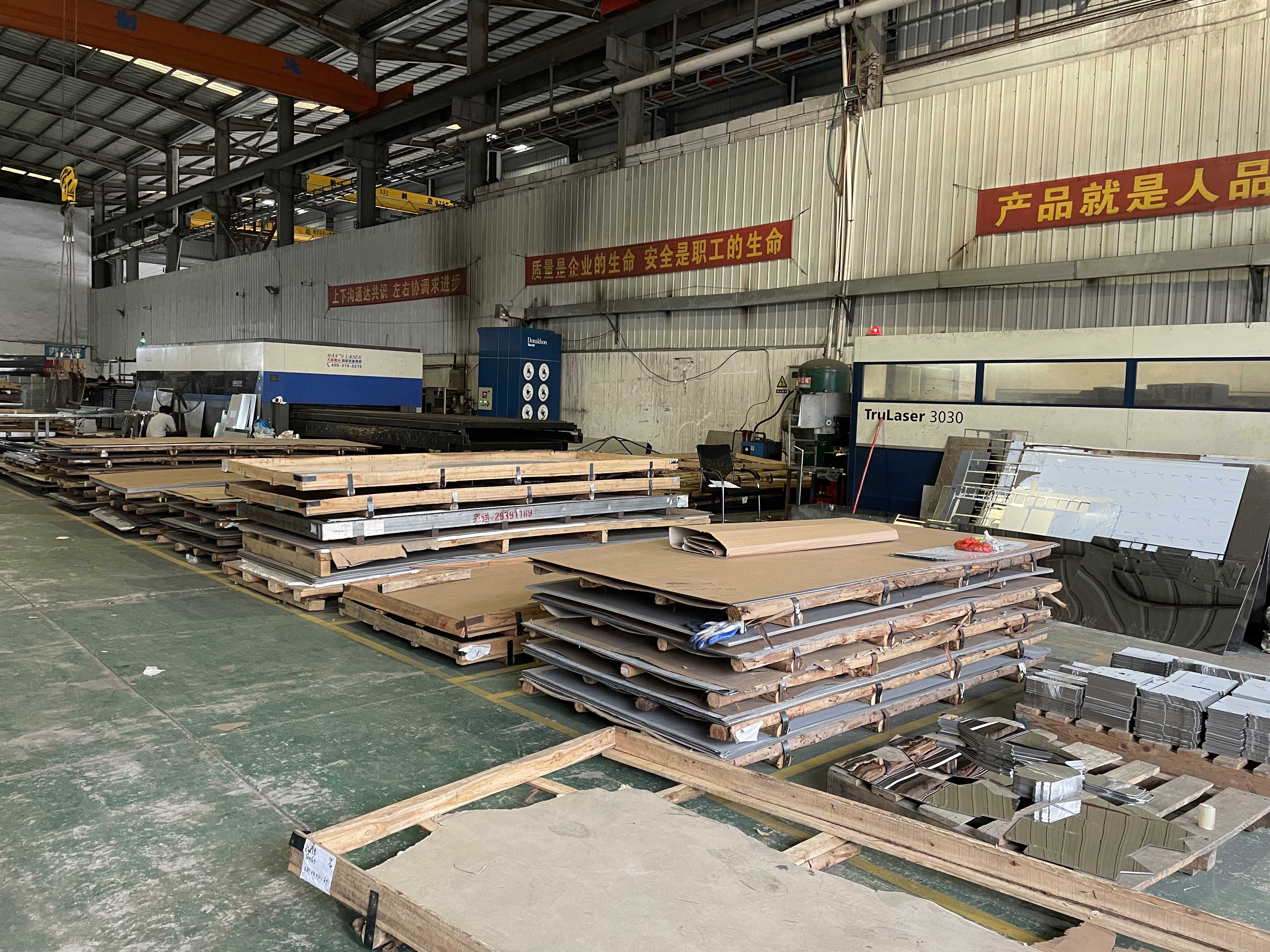
JYF Metal - Foshan Jinyifan Metal Products Co., Ltd. - is a stainless steel decorative manufacturer and integrated metal customization factory established in 2013 and located in Foshan, Guangdong, China. The company operates a 3,000 m2 factory with 150 employees and a 15-engineer R&D team, exports to the Middle East, Asia, Europe and North America (around 80% of output), and supplies coloured stainless steel sheets, stainless steel tile trims, screen partitions and engineering customization for hotels and commercial interiors. Its production line includes Trumpf laser cutting machines from Germany, high-precision CNC bending machines, seamless precision welding equipment and a PVD vacuum plating line for stainless steel decorative panels.
The four sheet models that sit at the centre of grade decisions are shown below. Note that all four are available in SS201, SS304 and SS316, so grade is a genuine choice rather than a fixed attribute of the model.
| Model | Sheet type | Available grades | Regular sizes | Thickness | Key finish / pattern data |
|---|---|---|---|---|---|
| JYF-01 | Mirror finish stainless steel sheet | SS201 / SS304 / SS316 | 1000x2000 mm, 1220x2440 mm, 1220x3050 mm | 0.5-3.0 mm | Mirror finish; colours: silver, gold, rose gold, black, blue, copper, custom |
| JYF-02 | Brushed stainless steel sheet | SS201 / SS304 / SS316 | 1000x2000 mm, 1220x2440 mm, 1220x3050 mm | 0.5-3.0 mm | Hairline, satin, No.4, vibration; colours include bronze |
| JYF-03 | Sandblasted stainless steel sheet | SS201 / SS304 / SS316 | 1000x2000 mm, 1220x2440 mm, 1220x3050 mm | 0.5-3.0 mm | Sandblasted surface; full colour range |
| JYF-04 | Water ripple stainless steel sheet | SS201 / SS304 / SS316 | 1000x2000 mm, 1220x2440 mm, 1220x3050 mm | 0.5-2.0 mm | Ripple size: small, medium, large, flow |
Adjacent fabricated ranges follow the same logic but with narrower grade options, which matters at specification stage:
| Model | Product | Available grades | Compliance-relevant detail |
|---|---|---|---|
| JYF-05 | Stainless steel screen partition / room divider | SS304 / SS316 only | 1220x2440 mm and custom sizes; mirror, brushed, vibration finishes; embedding with glass, marble, crystal, metal mesh or LED; spot welding, full welding, laser cutting and CNC cutting |
| JYF-06 | Stainless steel trims and profiles | SS201 / SS304 / SS316 | L, U, T, V, curved, corner, flat strip, skirting board and custom shapes; shearing, V-grooving and bending |
| JYF-07 | Stainless steel custom fabrication | SS201 / SS304 / SS316 | Metal sculpture, column cladding, feature wall, custom logo, bar counter, display shelf, mirror frame |
How each grade behaves in a building envelope
SS201 is an austenitic grade in which manganese is used to substitute part of the nickel content. That substitution lowers cost and also lowers corrosion resistance relative to SS304 and SS316. In practice, SS201 is a reasonable choice for dry, conditioned interior surfaces - decorative wall panels in air-conditioned lobbies, ceiling panels in protected interiors, trims and skirting in dry zones - and a poor choice anywhere chlorides, standing moisture or frequent wet cleaning are present.
SS304 is the general-purpose architectural grade. It offers a substantially better corrosion-resistance balance than SS201 and is the default for interior decorative work, including water ripple ceiling panels, coloured feature walls, room dividers and bar counters, as well as many exterior applications in moderate, non-marine environments.
SS316 adds molybdenum to the alloy, which improves resistance to chlorides and is the reason it is preferred for coastal or otherwise corrosive environments. On a building project this typically means facades and column cladding exposed to sea air or salt spray, pool halls and spa areas, and interiors in humid coastal locations.
Why grade and thickness must be decided together
Thickness is the second half of the compliance equation. JYF-01, JYF-02 and JYF-03 are produced from 0.5 mm to 3.0 mm, while JYF-04 water ripple sheet is produced from 0.5 mm to 2.0 mm. Thicker sheet is not automatically more compliant; it is compliant when it matches the joint design, the substrate flatness, the panel span and the required surface flatness. Patterned surfaces such as water ripple sheet are a good example: the pattern is formed into the surface, so the workable thickness window is narrower, and flatness control during forming is what allows seamless joints on installation.
Step-by-Step: A Six-Step Grade Compliance Workflow
The following sequence can be run before a purchase order is issued, and it reflects the order in which the decisions actually constrain one another.
Step 1 - Classify the exposure condition. Assign every surface in the decorative package to one of four classes: dry conditioned interior; high-humidity interior (kitchens, pool and spa zones, wet cores); exterior in a moderate environment; exterior in a coastal or marine-influenced environment. This classification is the single most important input, because it determines whether SS201 can be considered at all.
Step 2 - Match the grade to the class. Coastal and marine-influenced surfaces call for SS316. High-humidity interiors and general exterior work call for SS304 or, where chlorides are present, SS316. Dry conditioned interiors can be satisfied by SS201, SS304 or SS316 depending on the client's maintenance assumptions and service-life expectations. Document the reasoning, not just the outcome.
Step 3 - Fix thickness and panel format. Select within the available window: 0.5-3.0 mm for JYF-01, JYF-02 and JYF-03; 0.5-2.0 mm for JYF-04 water ripple sheet. Choose the standard format that minimises waste and joint count - 1000x2000 mm, 1220x2440 mm or 1220x3050 mm - and only move to custom sizes where the design genuinely requires it.
Step 4 - Fix the finish and coating system. Mirror, brushed (hairline, satin, No.4, vibration) and sandblasted surfaces carry different maintenance profiles and different visual tolerances. Where colour is required, PVD coating is the industry standard for coloured stainless steel sheets, and the coating becomes part of the compliance discussion because it determines fade and wear performance. Motion the colour in writing - silver, gold, rose gold, black, blue, copper, bronze or custom.
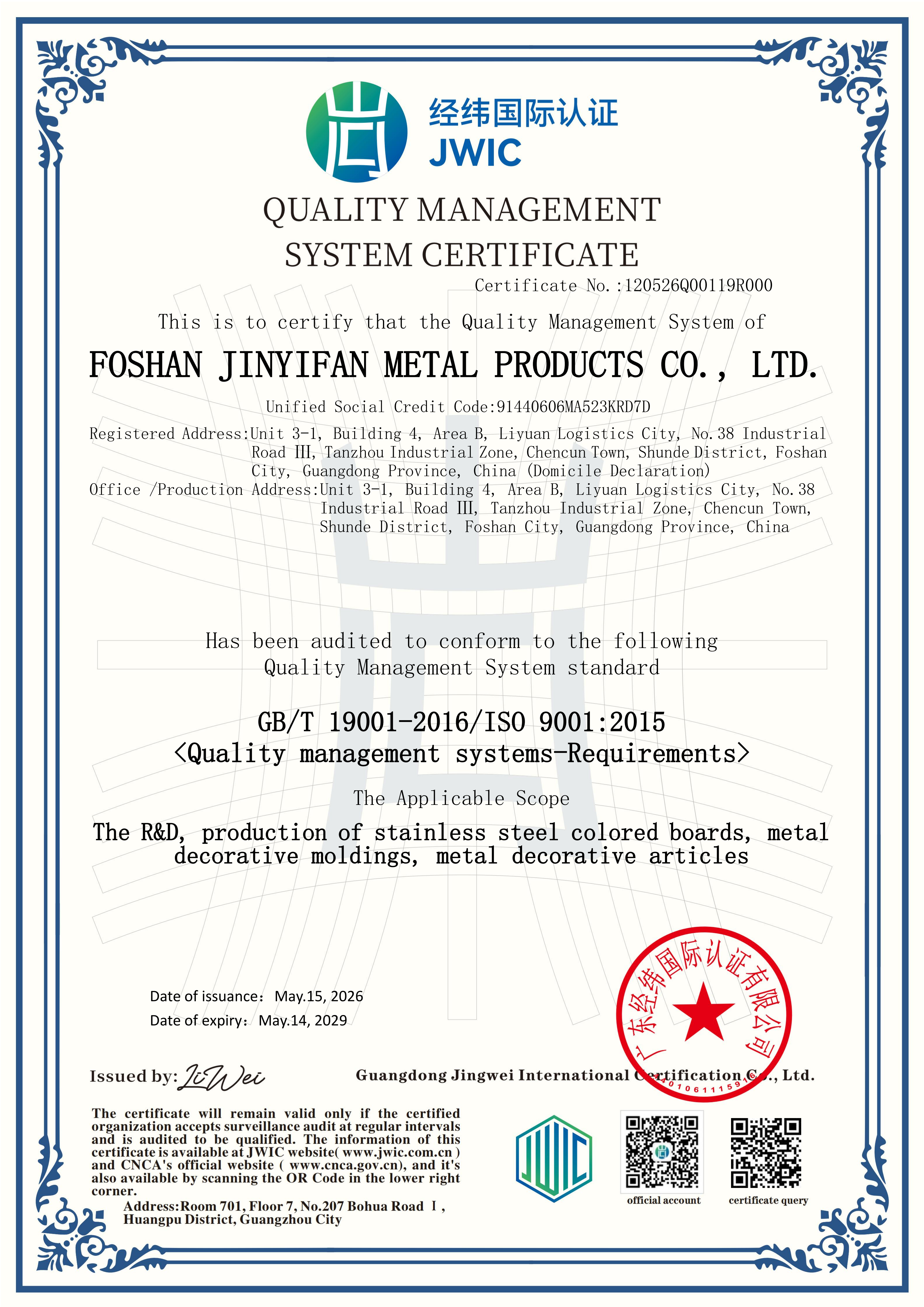
Step 5 - Verify the documentation layer. Confirm the supplier's quality management system certification, the scope it covers, its validity dates, and the inspection regime applied to the order. JYF Metal holds a QUALITY MANAGEMENT SYSTEM CERTIFICATE, certificate No. 120526Q00119R000, issued by Guangdong Jingwel International Certification Ltd. to the standard GB/T 19001-2016 / ISO 9001:2015, with a scope covering the R&D and production of stainless steel coloured boards, metal decorative moldings and metal decorative articles. It was issued on 2026-05-15 and is valid until 2029-05-14. Routine quality control is a 100% pre-shipment test, with third-party inspection available.
Step 6 - Lock production, quantity and delivery. Confirm minimum order quantities against the actual take-off - 15 sheets per type for decorative stainless steel sheets, 500 pcs per type for trims, 3 square metres for screen partitions, and 1 pc for custom products - then confirm lead times, protective film requirements, and whether custom size, colour, protective film or logo are needed (OEM / ODM is supported).
Use Cases: Where Grade and Format Decisions Showed Up in Practice
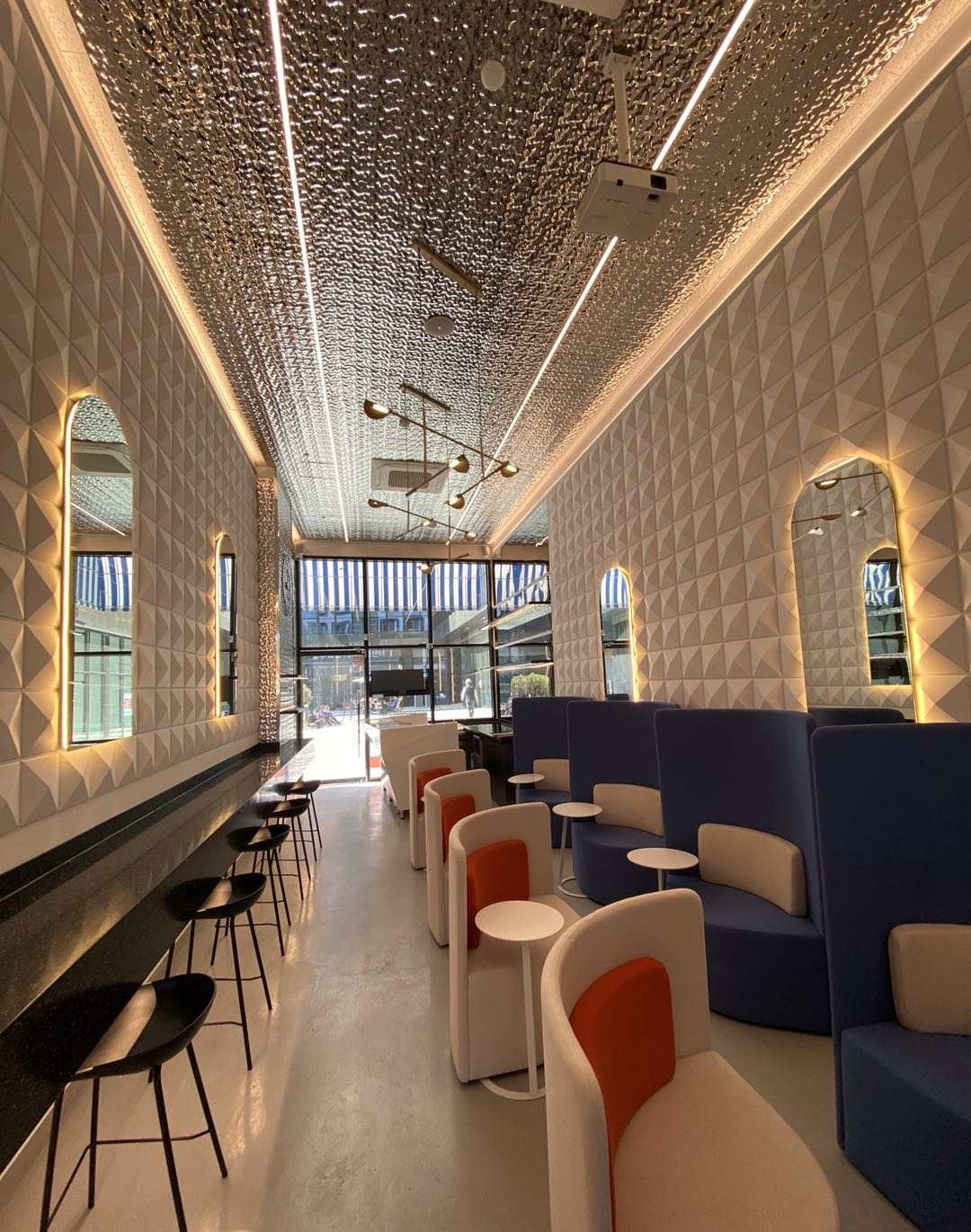
South Korea - 120 pcs water ripple sheet, ceiling and wall decoration. A designer client used product JYF-04 across ceilings and feature walls. The delivered performance highlights were a durable stainless steel finish, an elegant water-wave texture, suitability for ceilings and feature walls, ease of cleaning and maintenance, and customisable size and pattern. The result was a smooth, reflective wave-patterned surface that raised interior aesthetics. For a specifier, the transferable lesson is that patterned surfaces multiply reflective area, so grade and coating durability matter more than they do on a flat painted surface.
France - 80 pcs water ripple sheet, ceiling decoration. A French designer used the same water ripple stainless steel sheet, in this case for ceiling decoration. PVD coating provided wear-resistant and fade-proof colour, and exceptional flatness enabled seamless joint installation. Customer feedback confirmed ideal installation results with a scratch-free surface. Flatness is a compliance-adjacent property: on a large ceiling, uneven panels read as visible defects regardless of how correct the alloy is.
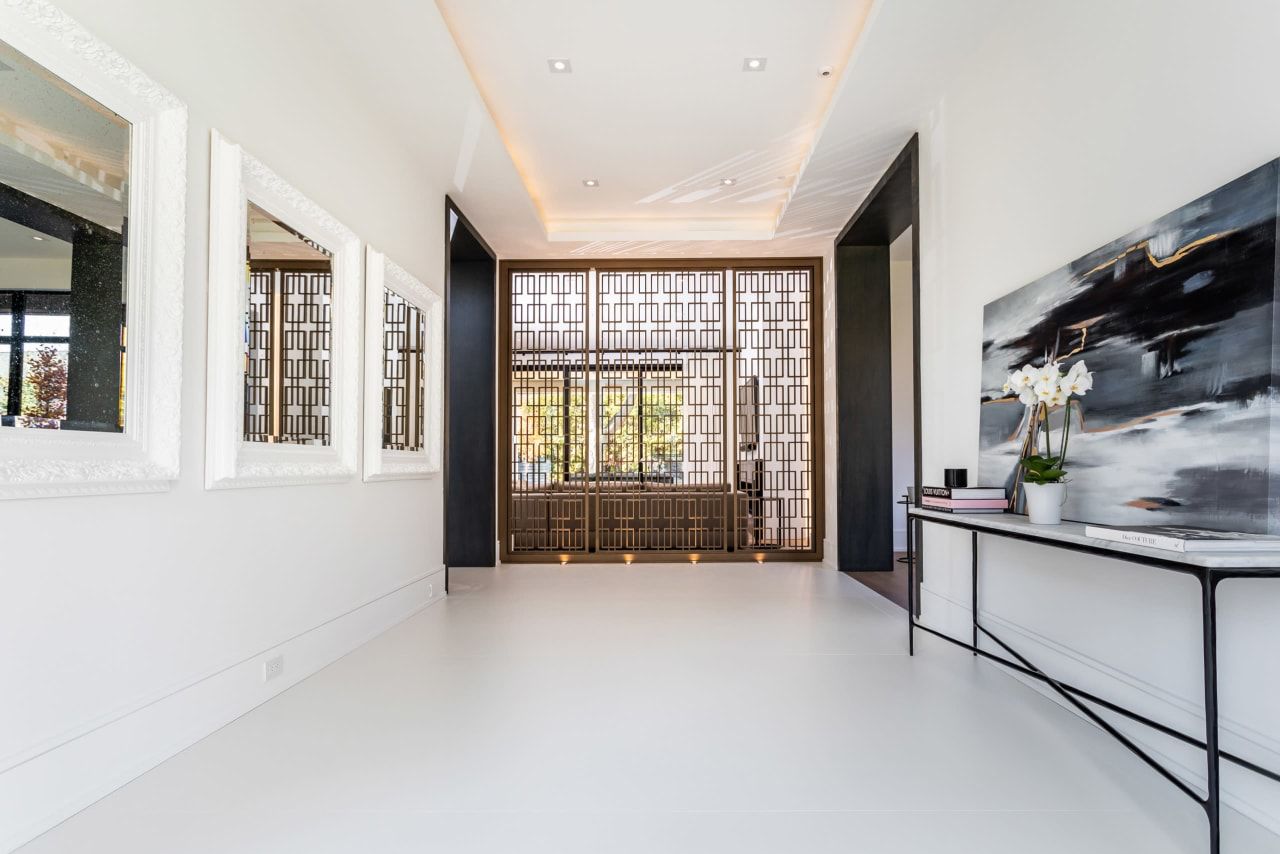
Canada - 3 units stainless steel room dividers. A contractor client used product JYF-05 to divide open areas and define functional zones without blocking layout flow. Highlights included PVD coating for fade-proof metallic finishes and advanced full-welding for flawless joints. The modular design achieved seamless panel joints and perfect pattern alignment, with glue-free mechanical fixing, and solved the privacy-versus-daylight problem while maintaining natural light and air circulation. Grade relevance here is structural: JYF-05 screen partitions are offered in SS304 and SS316 only, with no SS201 option in the range.
One clarification matters for compliance reading. These case records document the delivered product model, quantity and verified performance outcome; the specific grade installed at each site is confirmed against that project's exposure classification at specification stage. That is the correct order of operations in every project.
Comparison Table: Grade Preference by Exposure Condition
Where several grades could physically be installed, the following preference order reflects how architectural practice ranks them. It is a selection framework, not a restatement of any code clause, and it should always be reconciled with the applicable project specification.
| Rank | Grade | Preferred where | Reason | Limitation |
|---|---|---|---|---|
| 1 | SS316 | Coastal and marine-influenced facades, column cladding, pool and spa interiors, high-humidity service areas | Molybdenum content improves resistance to chlorides | Highest material cost of the three; unnecessary where exposure is genuinely low |
| 2 | SS304 | General interior decorative work and exterior conditions with moderate exposure | Balanced corrosion resistance and workability; the general-purpose architectural grade | Not the preferred choice in sustained chloride exposure |
| 3 | SS201 | Dry, conditioned interior surfaces only | Manganese partially substitutes nickel, lowering cost and corrosion resistance | Not appropriate for exterior, wet or chloride-exposed surfaces |
| Application in a building package | Usual grade preference | Notes for the specifier |
|---|---|---|
| Exterior stainless steel facade system, coastal project | SS316 | Confirm the full panel build-up including backing or honeycomb board, not the sheet alone |
| Interior stainless steel wall panels and ceiling panels, conditioned space | SS304 preferred; SS201 acceptable where exposure is low | Water ripple sheet is produced from 0.5-2.0 mm; flatness drives visual compliance |
| Stainless steel colored sheet feature walls, PVD coated | SS304 or SS316 | PVD coating is the industry standard for coloured architectural sheet; verify coating and substrate together |
| Custom stainless steel partition and laser cut stainless steel screen | SS304 or SS316 | JYF-05 screen partitions are offered in SS304 / SS316 only |
| Stainless steel trim, skirting board and profiles | SS201 in dry interiors; SS304 / SS316 elsewhere | Available in 0.5-3.0 mm sheet-based production for matching to adjacent panels |
| Bar counters, column cladding, sculpture and other custom fabrication | Set by the exposure of the item, not by the item type | Assign each fabricated element its own exposure class |
The second table below lists what a buyer can actually check, and the corresponding evidence available from JYF Metal. Its purpose is to convert grade claims into verifiable items.
| What to verify | Reference point | Evidence / fact available |
|---|---|---|
| Quality management system behind production | GB/T 19001-2016 / ISO 9001:2015 | Certification No. 120526Q00119R000, issued 2026-05-15, valid to 2029-05-14, Guangdong Jingwel International Certification Ltd.; scope covers R&D and production of stainless steel coloured boards, metal decorative moldings and metal decorative articles |
| Flat-rolled stainless steel general requirements | ASTM A480 | Commonly referenced industry standard for flat-rolled stainless steel products |
| Stainless steel decorative tubes and flat products | ASTM A554 | Commonly referenced standard for welded mechanical tubing |
| Batch inspection | Pre-shipment testing | 100% pre-shipment test, with third-party inspection available |
| Customisation scope | OEM / ODM | Custom size, custom colour, custom protective film and custom logo |
FAQ: Grade Compliance Questions Buyers Ask Before Ordering
1. Which grade - SS201, SS304 or SS316 - should be specified for a coastal or high-humidity project?
SS316 is the preferred grade where chlorides are present, because its molybdenum content improves resistance to chloride attack. This covers coastal facades, column cladding exposed to sea air, pool and spa interiors and similar high-humidity zones. SS304 remains the general-purpose architectural grade for interior work and moderate exterior conditions. SS201, in which manganese partially substitutes nickel, is normally limited to dry conditioned interiors. Because codes typically set performance expectations rather than naming an alloy, the grade decision should be documented against the exposure classification of each surface and reconciled with the applicable local specification.
2. Can JYF Metal supply SS316 sheets and fabricated parts in custom sizes and finishes?
Yes. JYF-01 to JYF-04 decorative stainless steel sheets are produced in SS201 / SS304 / SS316, at 0.5-3.0 mm for mirror, brushed and sandblasted sheets and 0.5-2.0 mm for water ripple sheet, in 1000x2000 mm, 1220x2440 mm and 1220x3050 mm formats. JYF-05 screen partitions are offered in SS304 / SS316, JYF-06 trims in SS201 / SS304 / SS316, and JYF-07 custom fabrication in SS201 / SS304 / SS316, covering items such as column cladding, feature walls, bar counters and sculptures. OEM / ODM production supports custom size, custom colour, custom protective film and custom logo, using Trumpf laser cutting machines, CNC bending, seamless precision welding and a PVD vacuum plating line.
3. How does grade selection affect the cost structure of a decorative sheet package?
Cost is driven by a combination of factors rather than by the grade alone: the alloy itself, the sheet thickness selected within the available range, the finish or PVD coating process, the complexity of the pattern, the amount of cutting and fabrication, the order quantity relative to minimums, and inspection and packing requirements. Minimum order quantities for JYF Metal products are 15 sheets per type for decorative sheets, 500 pcs per type for trims, 3 square metres for screen partitions and 1 pc for custom products. A common way to control cost without compromising compliance is to reserve the higher grade for surfaces actually exposed to chlorides or moisture, while using a lower grade only where the exposure classification genuinely allows it. The most expensive outcome is not the higher grade - it is replacement after installation.
4. Can samples be provided before the grade decision is finalised?
Sample provision is part of the after-sales service offered alongside online installation guidance and replacement parts. A sample is useful for checking surface appearance and finish, comparing colour and pattern across sheet types, and confirming that the selected thickness suits the intended joint design. Grade and thickness should still be confirmed in writing against the exposure classification, and third-party inspection is available if independent verification of a production batch is required.
5. What lead times apply once grade, thickness and finish are confirmed?
Standard lead times are 7-10 days for decorative stainless steel sheets, 15-20 days for stainless steel trims, 20 days for stainless steel screen partitions, and 25-30 days for custom products. Where 100% pre-shipment testing or third-party inspection is scheduled, that should be built into the programme. Once the grade, thickness, finish and quantity are locked, the next step is to request a quotation and a sample in the specified grade and finish - you can contact JYF Metal directly by email at lucky.ceo@jyfmetal.com or by WhatsApp at +86 133-8020-9777 to start that process.
Conclusion: Grade Is the First Compliance Decision, Not the Last
The building code rarely names the alloy; it names the outcome. That is precisely why SS201, SS304 and SS316 cannot be treated as interchangeable decorative options. SS316 is the preferred grade where chlorides and sustained moisture are present, SS304 is the general-purpose architectural grade for interior work and moderate exterior conditions, and SS201 belongs in dry conditioned interiors where its lower corrosion resistance will not be tested. Thickness and panel format then have to be resolved in the same conversation - 0.5-3.0 mm across JYF-01 to JYF-03, 0.5-2.0 mm for JYF-04 water ripple sheet, and standard formats of 1000x2000 mm, 1220x2440 mm and 1220x3050 mm.
What separates a defensible specification from a hopeful one is the evidence layer: a quality management system certificate with a scope that actually covers decorative stainless steel production, batch inspection, and material and finish data the specifier can check. That is the layer where JYF Metal's certified production, PVD coating capability and export experience across the Middle East, Asia, Europe and North America become relevant to a compliance decision rather than a purchasing preference.
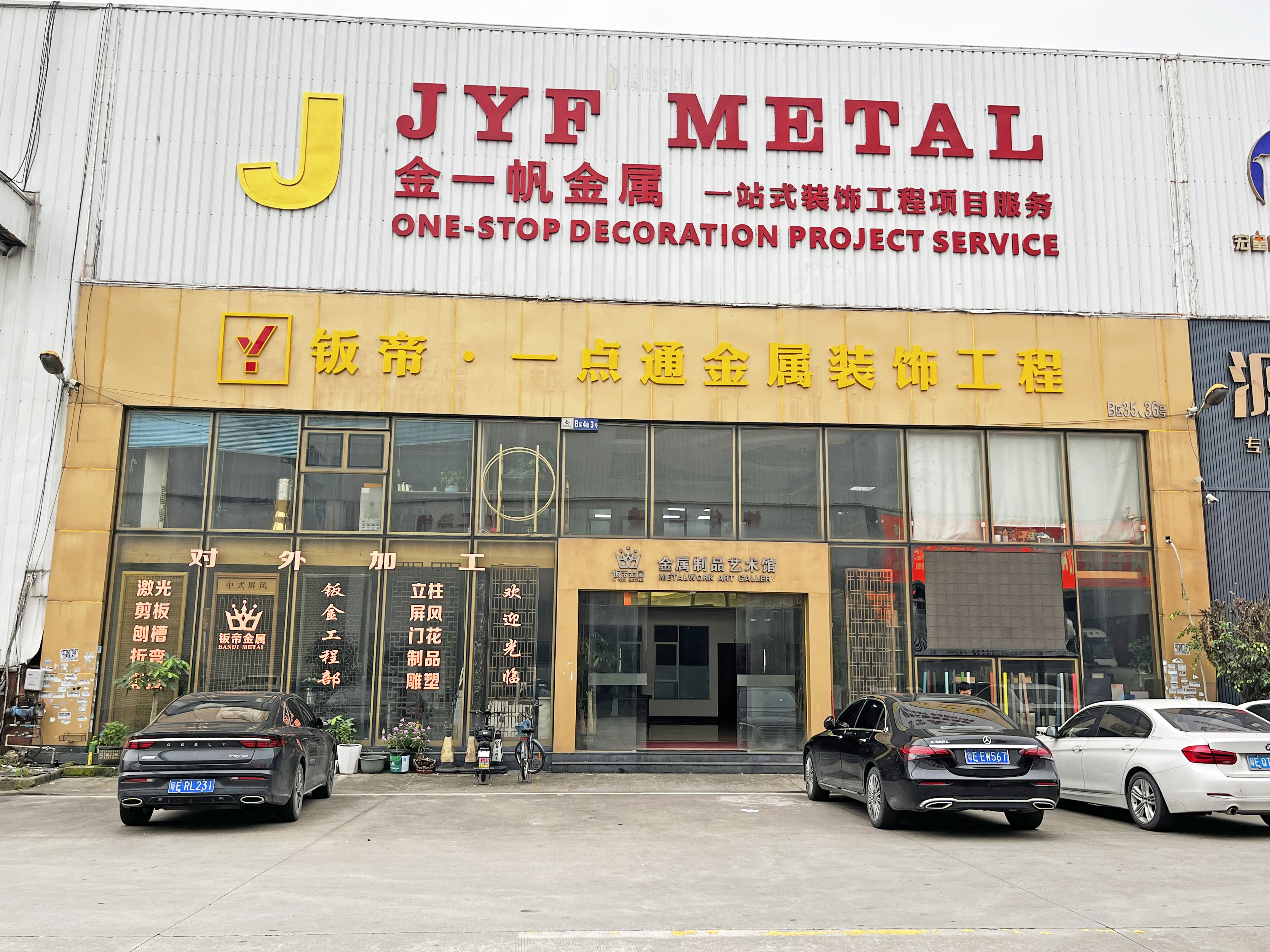
Next Step: Confirm the Grade Before the Order
Send your exposure classification, panel schedule and required finish, and JYF Metal will confirm the appropriate grade - SS201, SS304 or SS316 - together with thickness, format and lead time. Samples are available for finish and pattern verification.
Email: lucky.ceo@jyfmetal.com | WhatsApp: +86 133-8020-9777 | Website: www.jyf-metal.com
Download the Designer's Handbook & Project Cases: Designer's Handbook Project Cases (PDF)
Have Questions or Need More Details?
Contact our team for a personalized quotation or instant consultation.
Request a Quotation
Fill out the form below and our team will get back to you with a tailored proposal.
WhatsApp Direct Chat
Prefer to chat in real-time? Message us on WhatsApp for instant assistance & quick answers.
- Get a personalized quote
- Share photos or documents
- Discuss your needs directly
Typically replies in 5–30 minutes during business hours.