
Stainless Steel Wall & Ceiling Panels: Material Grades, Finishes, and Compliance for Architects
Stainless Steel Wall & Ceiling Panels: Material Grades, Finishes, and Compliance for Architects
When specifying architectural stainless steel decoration for wall and ceiling systems, the core question is not just “which panel looks best.” It is: which material grade, surface finish, and compliance standard will perform reliably over the life of the building? This guide compiles the key specification parameters for stainless steel wall panels, ceiling panels, and related decorative systems, based on the manufacturing capabilities of Foshan Jinyifan Metal Products Co., Ltd. (JYF Metal) and current industry practice.
Why Wall and Ceiling Panels Require a Defined Specification
Stainless steel panels are specified for high-traffic commercial interiors because they offer a combination of durability, fire resistance, and a premium visual finish. Unlike painted surfaces or timber panels, stainless steel does not chip or delaminate under normal use. It also supports a wide range of surface treatments—mirror, brushed, sandblasted, and water ripple—that give designers a material vocabulary for creating distinct spatial identities.
However, there is no single “stainless steel” that fits every application. The material grade (201, 304, or 316), the coating method (PVD or other), the thickness, and the panel construction all determine whether a project will meet its performance requirements. In this article, we focus on the specification parameters that architects and contractors should define before issuing an inquiry, drawing on the product systems available from JYF Metal.
Material Grades: 201, 304, and 316 Explained
The three most common stainless steel grades used in decorative wall and ceiling applications are 201, 304, and 316. Each offers a different balance of corrosion resistance, cost, and suitability for the environment.
- 304 stainless steel is the most widely used grade for interior architectural applications. It offers excellent corrosion resistance, good formability, and is suitable for most commercial indoor environments, including hotels, retail spaces, and lobbies.
- 316 stainless steel adds molybdenum, improving resistance to chlorides and salt. It is recommended for coastal environments, outdoor installations, and areas exposed to chemicals or de-icing salts.
- 201 stainless steel is a lower-cost alternative with lower corrosion resistance. It is sometimes used for purely decorative interior elements in dry, controlled environments where budget is the primary constraint.
JYF Metal offers decorative stainless steel sheets, trims, screen partitions, and custom fabrications in 201, 304, and 316 grades. The choice between these grades should follow a simple logic: interior walls and ceilings in standard commercial spaces typically use 304; coastal or outdoor installations should upgrade to 316; decorative trims and profiles may use 201 when the environment is benign and cost targets require it.
Surface Finishes: From Mirror to Water Ripple
Surface finish determines both the aesthetic and the maintenance characteristics of stainless steel panels. The following finishes are available in JYF Metal's standard product range:
Mirror Finish
A mirror finish is achieved by polishing the sheet to a highly reflective surface. It can be applied in silver, gold, rose gold, black, blue, copper, and custom colors. Mirror panels are commonly used in feature walls, columns, and elevator interiors where the reflective quality expands the visual space. Regular size options include 1000×2000 mm, 1220×2440 mm, and 1220×3050 mm, in thicknesses from 0.5 to 3.0 mm.
Brushed (Hairline / Satin) Finish
The brushed finish features a unidirectional, fine-line texture that hides fingerprints and scratches better than a full mirror. It is offered in hairline, satin, No.4, and vibration patterns, with the same size and thickness ranges. This finish is well suited to surfaces with frequent human contact—wall panels beside elevators, counter fronts, and door frames.
Sandblasted Finish
Sandblasting creates a matte, softly textured surface with a diffused reflection. It is available in colors such as champagne gold, black, and blue. This finish is often used for statement walls and areas where glare must be minimized.
Water Ripple Finish
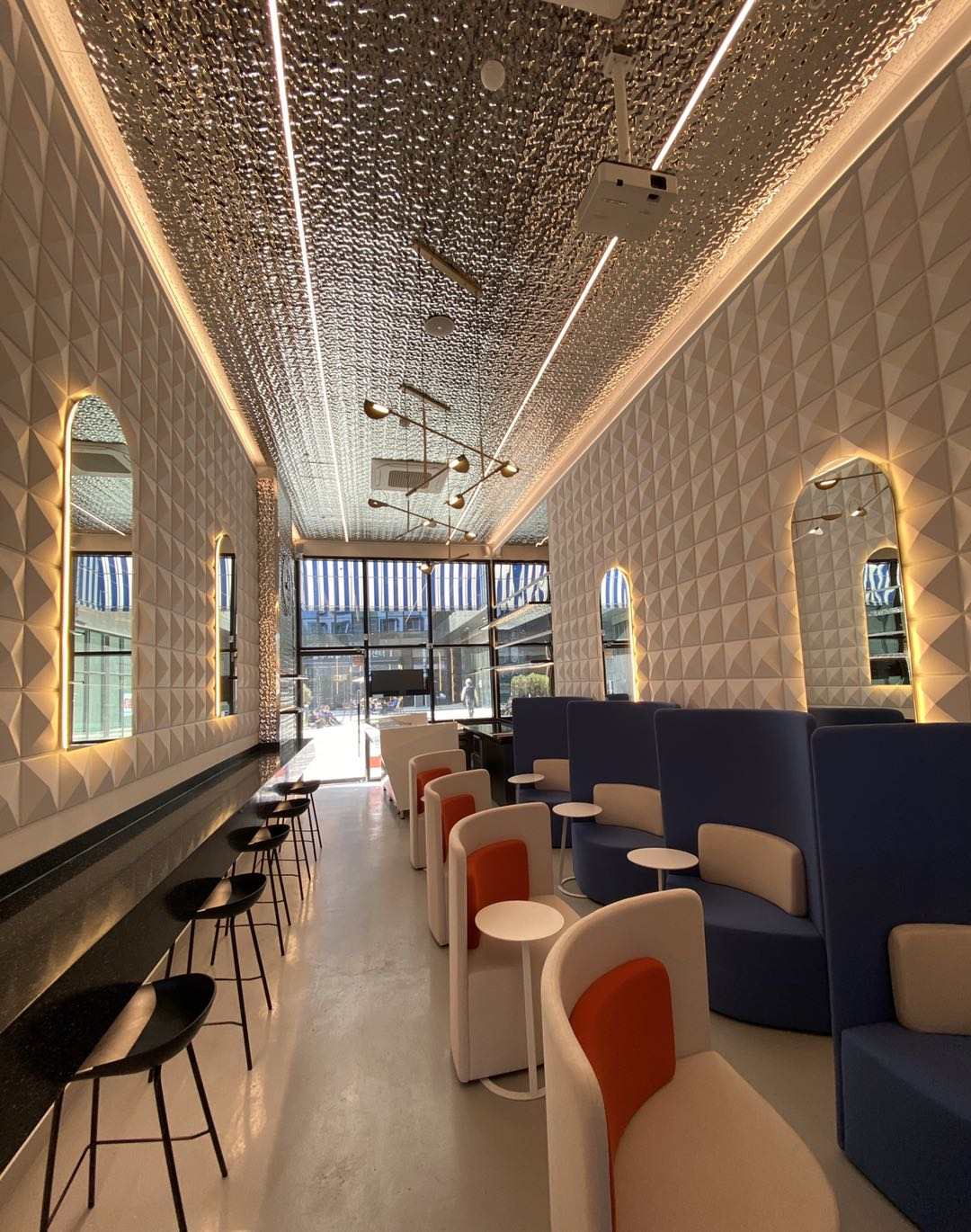
Water ripple stainless steel sheet is produced by pressing a wave-like texture into the metal, which creates a dynamic, shimmering effect when light passes across the surface. It is available in silver, gold, rose gold, black, blue, copper, and custom colors, with ripple sizes from small to large, including a flowing wave pattern. The sheet thickness ranges from 0.5 to 2.0 mm, and the standard sizes are the same as for other sheets.
PVD Coating: The Standard for Colored Stainless Steel
PVD (Physical Vapor Deposition) coating is the industry standard for producing colored stainless steel sheets for architectural use. The process deposits a thin, hard layer of titanium nitride or similar compounds onto the stainless steel surface in a vacuum chamber. The result is a colored surface (gold, rose gold, black, bronze, blue, etc.) that is highly wear-resistant and does not fade or peel under normal conditions.
JYF Metal operates a PVD vacuum plating line for stainless steel decorative panels, which allows for in-house control of color consistency across large production runs. For architects, this matters because a project may require dozens or hundreds of panels with matching color; an in-house PVD line enables the manufacturer to maintain that consistency to a higher standard than outsourcing the plating step.
Panel Types: Solid, Ripple, Honeycomb, and Perforated
Wall and ceiling panels are available in several structural forms. Each type serves a different purpose in architectural design:
- Solid decorative sheets (mirror, brushed, sandblasted, or water ripple) are the most common. They are installed on flat surfaces using adhesive or dry-hanging systems.
- Honeycomb panels consist of a stainless steel face sheet bonded to a lightweight aluminum honeycomb core. They provide high strength-to-weight ratios, which is valuable for ceiling panels and large wall surfaces where weight reduction is critical.
- Perforated metal panels have a pattern of holes that can be used for acoustic control, ventilation, or purely visual effect. They are often used as feature walls and decorative screens.
- Double-curved ceilings and shaped panels are fabricated for more complex architectural geometries. JYF Metal’s production line supports curved surfaces and non-standard shapes through precision welding, CNC bending, and custom tooling.
System Components: Trims, Skirting, and Screens
A complete architectural metal package is more than panels. The transitions between surfaces—at the floor, the corners, and around openings—require precisely fabricated profiles to achieve a professional finish.
Stainless steel trims are manufactured in L, U, T, V, curved, corner, flat strip, and skirting board shapes, with mirror, brushed, vibration, or sandblasted finishes. These decorative profiles are used for edge finishing, wall joints, transition strips, and floor-to-wall transitions. The manufacturing process includes shearing, V-grooving, and bending to achieve precise dimensions.
Screen partitions and room dividers are a separate product family. They are typically fabricated in 304 or 316 stainless steel, with laser cutting and CNC cutting for pattern creation, followed by spot welding or full welding. They can be filled with glass, marble, crystal, metal mesh, or LED lights. The standard module size is 1220×2440 mm, with full customization available for project-specific dimensions.
From Drawing to Installation: The Custom Fabrication Process
For custom stainless steel wall and ceiling systems, the production workflow at JYF Metal follows a structured sequence:
- Design review and drawing optimization. The engineering team reviews the architectural drawings, identifies complex shapes, and refines the production plan. The goal is to ensure that all dimensional tolerances, joint alignments, and surface material requirements are feasible before cutting begins.
- Prototype production. For complex shapes and large orders, a prototype sample is produced first. This allows the designer to verify the curvature, color, and finish before committing to mass production.
- Material selection and cutting. The specified grade (201/304/316) is sourced, and sheets are cut with the planned dimensions. JYF Metal’s equipment includes Trumpf laser cutting machines from Germany for precision cutting.
- Forming and welding. CNC bending machines form the metal into the required shapes. Seamless precision welding equipment is used to join panels and profiles while minimizing visible welds.
- Surface treatment. The panels are finished with the selected surface treatment—mirror, brushed, sandblasted, or water ripple—and, if colored, passed through the PVD coating line.
- Quality control and packing. Products are inspected for dimensional accuracy, surface defects, and color consistency. They are then packed with protective film to prevent scratching during transport, with 100% pre-shipment inspection available.
Project Applications: Hotels, Commercial Complexes, and Public Buildings
Stainless steel wall and ceiling panels are used across a range of building types. The following scenarios illustrate how different product choices meet project requirements:
Hotel Lobbies and Restaurants
In hotel interiors, water ripple stainless steel sheets and colored panels create focal walls, ceiling features, and elevator lobbies. JYF Metal has supplied water ripple sheets for ceiling and wall decoration in projects in France and South Korea, with quantities of 80 pcs and 120 pcs respectively. The feedback from these projects emphasized seamless installation, scratch-free surfaces, and the dynamic visual effect created by the wave pattern under lighting.
Commercial Complexes and Public Buildings
Large public spaces require materials with high durability and minimal maintenance. For these projects, 304 or 316 grade stainless steel with brushed or sandblasted finishes is a common specification. Column cladding, curtain wall decoration, and elevator decorative panels are typically fabricated as custom units, manufactured to match the building’s exact dimensions. These components are designed to withstand high-traffic contact and maintain their appearance over years of service.
High-End Residences and Clubs
For residential projects and private clubs, screen partitions made of stainless steel with glass or marble infill are popular for dividing spaces while maintaining light flow. These laser-cut screens can incorporate intricate patterns and PVD-coated colors such as rose gold and bronze. The product is delivered as a modular system with mechanical fixing, which supports faster installation without the need for wet adhesives.
Custom Fabrications: Beyond Standard Panels
When a project requires a one-off sculpture, feature wall, bar counter, or custom logo, the fabrication route is used. The JYF Metal custom fabrication unit handles metal sculpture, column cladding, feature walls, bar counters, display shelves, and mirror frames in materials including 201, 304, and 316 stainless steel. This flexibility allows architects to introduce bespoke metal elements that are fully coordinated with the standard panel systems used elsewhere in the building.
Comparison: Specifying Stainless Steel Wall and Ceiling Systems
| Application Area | Recommended Grade | Recommended Finish | Typical Panel Type |
|---|---|---|---|
| Interior feature walls (hotels, retail) | 304 | Water ripple, mirror, brushed | Solid sheet, 0.5–2.0 mm |
| Ceilings (large spans) | 304 or 316 | Brushed, sandblasted | Honeycomb panel for weight reduction |
| Elevator interior walls | 304 | Brushed (fingerprint resistant) | Solid sheet, 0.8–1.5 mm |
| Coastal / outdoor curtain wall | 316 | Sandblasted, brushed | Honeycomb or perforated panel |
| Column cladding (high-traffic lobbies) | 304 or 316 | Mirror or brushed | Custom fabricated, curved if required |
| Decorative screens / partitions | 304 or 316 | PVD coated (gold, rose gold, black) | Laser-cut screen with infill |
| Skirting, trims, edge profiles | 201 or 304 | Brushed, mirror, vibration | L/U/T/V/curved shapes |
Compliance and Quality Management
For international projects, product compliance is a mandatory requirement. Fabricators should be able to provide evidence of a functioning quality management system aligned with recognized standards.
JYF Metal is ISO9001 certified under certification number 120526Q00119R000, issued by Guangdong Jingwel International Certification Ltd. The certificate covers the R&D and production of stainless steel colored boards, metal decorative moldings, and metal decorative articles. This certification provides documentation that the factory operates with defined quality control procedures—from raw material inspection to finished goods—rather than relying on ad-hoc checks.
In addition to internal quality control, third-party inspection is available for projects that require independent verification. The company's export experience covers the Middle East, Asia, Europe, and North America, and includes familiarity with international export processes and logistics coordination.
Production Capacity, Lead Times, and MOQs
Knowing a supplier’s capacity, lead time, and minimum order quantity (MOQ) is essential for planning large-scale projects. The following figures are based on JYF Metal's current production parameters:
| Product Category | Lead Time | MOQ |
|---|---|---|
| Decorative stainless steel sheets | 7–10 days | 15 sheets per type |
| Stainless steel trims | 15–20 days | 500 pcs per type |
| Stainless steel screen partition | 20 days | 3 square meters |
| Custom products (sculpture, bar counter, etc.) | 25–30 days | 1 piece |
These parameters support a phased procurement approach. Standard decorative sheets can be produced quickly, while custom fabrications require a longer cycle for engineering and production. For projects with multiple product categories, planning the order so that custom items are released first and standard panels follow can shorten overall delivery time.
Case Reference: Water Ripple Ceiling Panels in South Korea
A case from JYF Metal illustrates the specification-to-delivery process for architectural stainless steel panels. A designer in South Korea required 120 pieces of water ripple stainless steel sheet for a ceiling and wall decoration project. The sheets were supplied with a smooth, reflective wave-patterned surface in a custom color and size. The key requirements were durability, easy maintenance, and applicability to both ceiling and feature wall installation.
From the project feedback, the defining characteristics were the elegant water-wave texture, customizable size and pattern, and the ease of cleaning and maintenance. The installation covered both surfaces with a single product type, demonstrating how one material specification can unify a space-planning concept across multiple planes. The intended service life was 5–10 years, consistent with the durability expectations for commercial interior stainless steel.
Requesting a Quotation: What to Include
To receive an accurate quotation and production timeline, provide the supplier with the following specification data:
- Material grade (201, 304, or 316). If in doubt, specify 304 for interiors and 316 for coastal or outdoor installations.
- Surface finish (mirror, brushed, sandblasted, or water ripple) and, for colored finishes, the exact PVD color reference.
- Panel dimensions (length × width × thickness) and the total quantity.
- Panel construction (solid sheet, honeycomb panel, perforated, or double-curved).
- Edge details and joint requirements (shaped profiles, trims, expansion gaps).
- Relevant drawings or reference images. JYF Metal supports custom orders based on drawings or samples.
- Project timeline and destination port. This allows the supplier to confirm lead time and logistics arrangements.
For projects that need independent verification of production quality, third-party inspection can be arranged before shipping. The quality control system includes 100% pre-shipment testing and the ability to provide replacement parts if needed.
FAQ
What certifications does JYF Metal hold for architectural stainless steel products?
JYF Metal is ISO9001 certified. The certification number is 120526Q00119R000, issued by Guangdong Jingwel International Certification Ltd. The scope covers the R&D and production of stainless steel colored boards, metal decorative moldings, and metal decorative articles, and the standard is GB/T 19001-2016/ISO 9001:2015.
Which stainless steel grade should I choose for interior wall panels—304 or 316?
For most interior commercial spaces, 304 is the recommended grade because it provides sufficient corrosion resistance and a stable surface finish at a moderate cost. Choose 316 for coastal environments, outdoor installations, or areas with exposure to chlorides or aggressive cleaning chemicals, because the molybdenum content in 316 gives it higher resistance to pitting and rust.
What is the lead time for custom stainless steel ceiling panels?
Decorative stainless steel sheets typically require 7–10 days of production time. If your project uses honeycomb panels, double-curved ceilings, or shaped panels, additional time is required for the forming and bonding processes. For screen partitions, lead time is approximately 20 days. Custom fabricated products (such as column cladding or bar counters) generally need 25–30 days.
Can I order a sample before committing to a full production run?
Yes. JYF Metal supports sample provision, and custom orders can be based on drawings or samples. For colored or water-ripple finished panels, requesting a physical sample is recommended because color perception varies between screens. The MOQ for standard decorative sheets is 15 sheets per type, while custom products can be ordered starting from 1 piece.
What after-sales support is available for international buyers?
JYF Metal provides online installation guidance, sample provision, and replacement parts as part of its after-sales support. For screen partitions, the modular mechanical fixing design supports fast installation without wet adhesives. The company also has export experience across the Middle East, Asia, Europe, and North America, and can assist with export clearance and logistics coordination.
Have a project that needs specification review or a sample panel?
Send your drawings or material requirements directly to lucky.ceo@jyfmetal.com or contact +86 133-8020-9777 (WhatsApp available) to discuss your requirements.
Conclusion: A Specification-Driven Approach to Stainless Steel Decoration
Architectural stainless steel wall and ceiling panels perform best when specified precisely. By defining the material grade, surface finish, panel construction, and compliance requirements at the outset, you enable suppliers to produce parts that fit correctly, match visually across the entire scope, and withstand the specific conditions of the building environment.
For JYF Metal, projects range from standard decorative sheets to complex custom screen partitions and sculptures. The in-house production capabilities—PVD plating, laser cutting, CNC bending, and precision welding—support this full range. The ISO9001 certification provides a documented quality foundation, while the lead times and MOQs above serve as realistic planning inputs for design teams and contractors.
When you are ready to move from concept to procurement, sending a complete specification—drawings, grade, finish, size, and quantity—will get you the most accurate response. It is the fastest route from a design idea to a manufactured panel that meets both visual and structural expectations.
Have Questions or Need More Details?
Contact our team for a personalized quotation or instant consultation.
Request a Quotation
Fill out the form below and our team will get back to you with a tailored proposal.
WhatsApp Direct Chat
Prefer to chat in real-time? Message us on WhatsApp for instant assistance & quick answers.
- Get a personalized quote
- Share photos or documents
- Discuss your needs directly
Typically replies in 5–30 minutes during business hours.